Download PDF

Nobody should age unwatched.

CareOS phones an elderly person every day, in their own language, on an ordinary phone.

It listens, notices what changed, and turns the call into care someone can act on.

One engine, 17 languages, two customers: care organisations worldwide, and the 304 million people who live far from their parents.

Pre-seed · Solo founder · Live in production

careos.co.in · 17 languages · no app on the elder's side
01
Who is building it

An engineer who has built, shipped and sold AI products before.

Aryan Kumar, founder of CareOS

Aryan Kumar · IIT Madras · Lead AI Engineer in Japan

Role: Lead AI Engineer in Japan, shipping production AI systems that regulated businesses depend on. Previous exit: built Donna, a personal AI assistant, from scratch and sold it to SpringCube.

Research: early detection of Parkinson's and Alzheimer's, which became NeuroConnect, a community diagnostic app presented at INSEAD Paris. That research is the thesis: in aging, the signal is behavioural and early, long before it is clinical.

CareOS, built from scratch, entirely solo: the 17-language voice agent, streaming telephony, mid-call emergency detection, backend, security, two web apps, a mobile app, and live billing. Sub-second voice, encrypted health data, 484 automated tests, live in production with paying customers.

He is also the customer: an immigrant in Osaka with parents in another country. Backed by the startup programs of Anthropic, OpenAI, AWS and Deepgram.

02
The problem

In aging, the signal is behavioural, gradual, and daily.

Sleep. Appetite. Mood. Routine.

Decline shows up here long before it is ever clinical. A monthly visit and an annual scan cannot see it.

The care manager can act, but can't watch.

Carries 45 or more. Visits monthly. Everything between visits is invisible.

The child abroad can watch, but can't act.

Eight time zones away. Hears 'I'm fine' on a Sunday call, and believes it.

Both are asking the same question every day: is my person okay today?

MHLW 令和7年度介護事業経営概況調査: ~45–46 users per full-time care manager (FY2024), up from ~42.7 in FY2021
03
Why now · the technology

Voice AI crossed the threshold where a phone call stops feeling like a machine.

0.5
Llama 3.3 70B
(Groq, shipped)
0.3
Mistral Nemotron
(en/ja)
0.2
Llama 3.1 8B
25.0
Llama 3.3 70B
(other host)
Seconds to first spoken word

Under one second it reads as conversation; at 25 seconds an elderly person assumes the line is dead and hangs up. And this now holds in Hindi, Tamil and Bengali, not just English. That is the unlock for every market outside the West, and it is very recent.

Measured on the CareOS production prompt, 2026-07-30. The 25s figure is why we moved providers. One slow model took down the whole call.
04
Why now · the capital

The capital already moved. It went to operations, not companionship.

Cera (incl. debt)
150
DUOS
130
Hippocratic AI
126
Assort Health
120
Inspiren
100
Sensi.AI
45
Patronus (consumer)
12
Meela (consumer)
3.5
Raised, US$ millions (2025–26)

Every one of the eight largest rounds sells to agencies, facilities or payers. The only pure consumer-companion rounds were an order of magnitude smaller. That is exactly why CareOS sells B2B first and families second.

Company announcements 2025–2026. Hippocratic AI valued at $3.5B; Assort Health $1.2B. Most valuations undisclosed.
05
What CareOS is

One engine. Two buyers. The same daily call.

The call

Every day, in their language, on their own phone. No app, no device, no setup for the elder.

The memory

Everything said, held in one searchable place: medications, moods, the name of the grandchild.

The record

A drafted care note, a risk score, and a task list, all waiting for a human to approve.

Care organisations buy the record. Families buy the peace of mind. Same engine, in 17 languages. The elder does nothing: no app, no device, no onboarding. That is the whole design, and it survives cognitive decline.

06
Product · the workspace

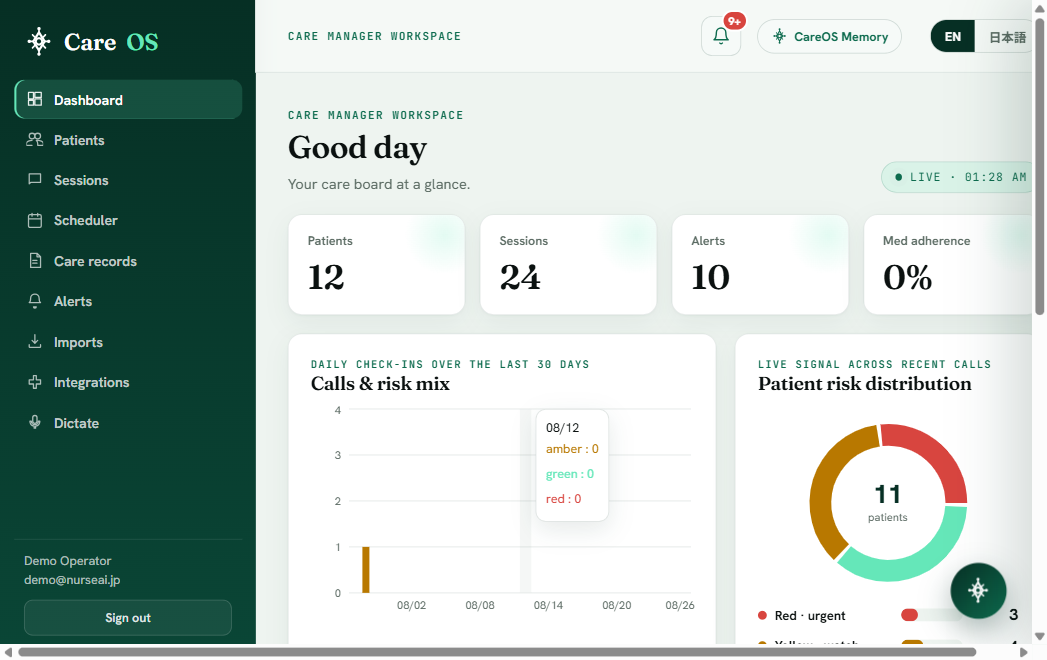
The care manager opens one screen and knows who to worry about.

The CareOS care-manager workspace: one screen showing the patient risk queue in red, amber and green.

A risk queue in the order a care manager actually works. Every call transcribed, summarised, scored, and drafted into a record awaiting approval.
careos-crm.vercel.app
07
Product · one memory per patient

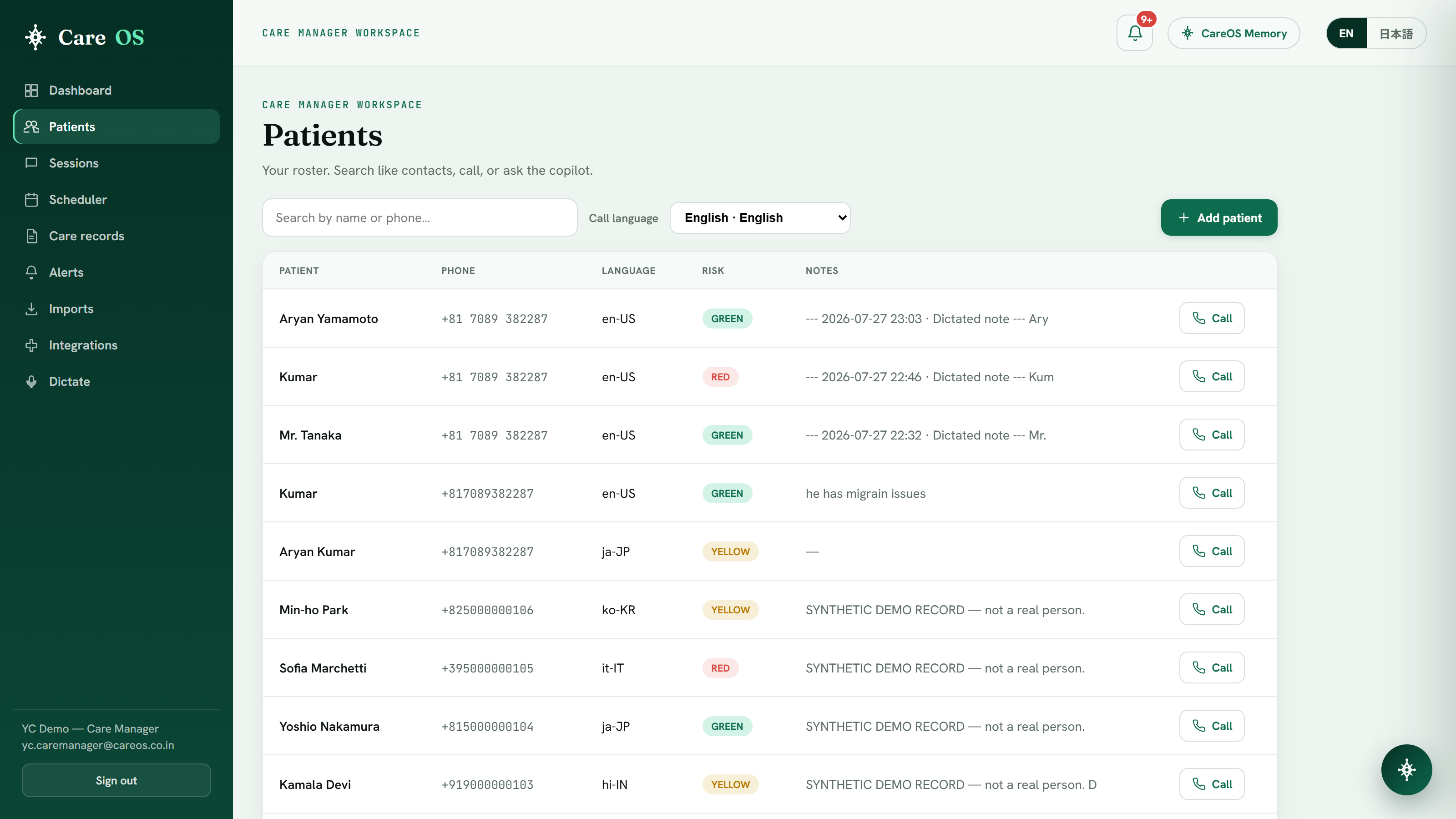
Every patient, every call, every medication. One searchable place.

The CareOS patient roster: every patient with their risk state, last call, and full history one click away.

The paper file, the phone log and the care manager's memory, replaced by one screen that never forgets. This is the memory the record is drafted from.
08
Product · the alert

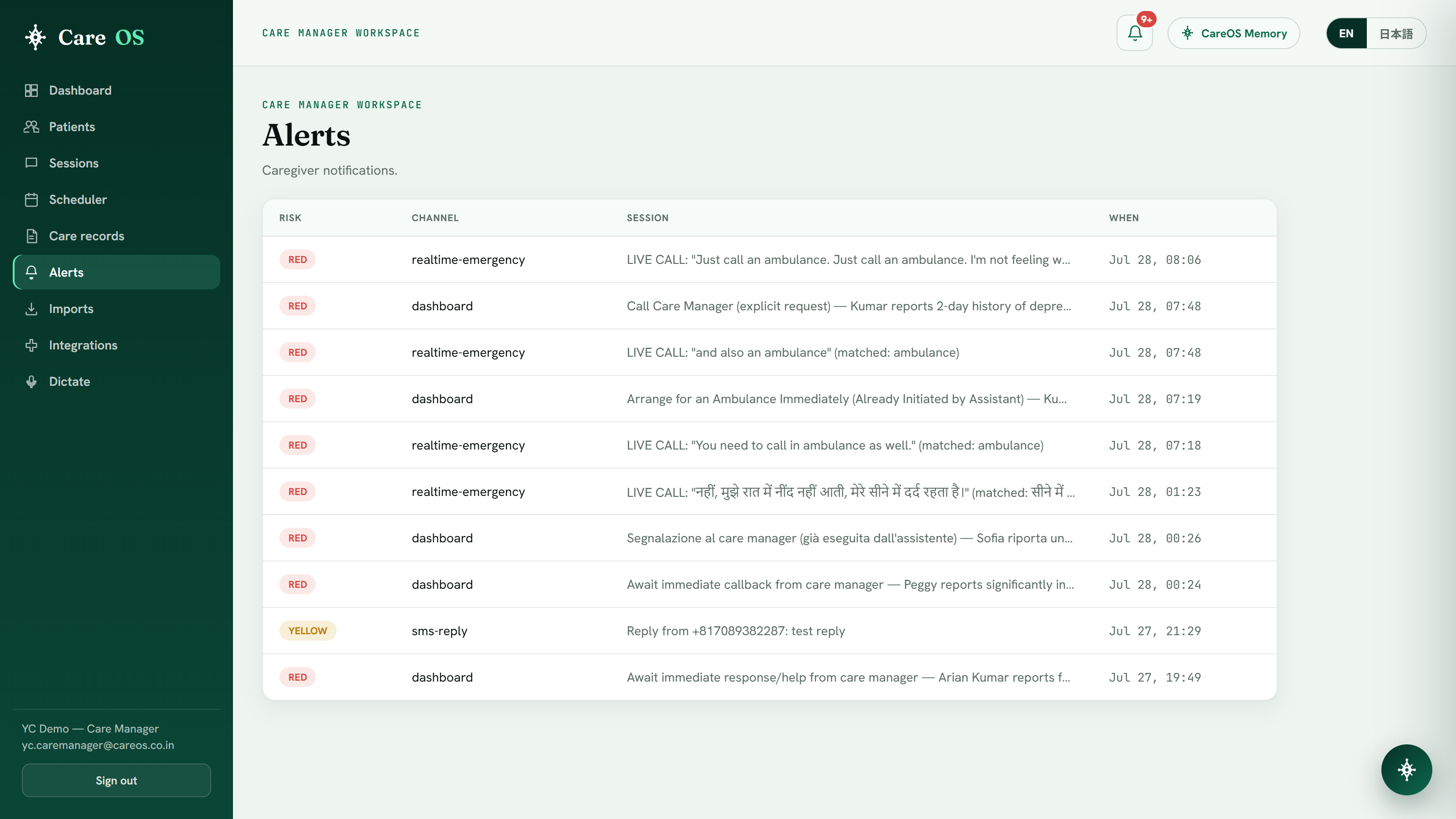
Chest pain in Hindi, on a dashboard in English, in seconds.

A CareOS alert: chest pain reported on a call in Hindi, surfaced on the care manager's dashboard in English within seconds.

Detected mid-sentence in any supported language (negation handled: 'I can't breathe' fires, 'it doesn't hurt' does not) → RED on the dashboard while the patient is still on the line → SMS to every emergency contact, with an opt-in live conference bridge. Built and running, not roadmap.

09
The principle

AI drafts. A human signs. Always.

No care record is ever filed without a person approving it. No health fact is written to a parent's profile without their child confirming it. No money ever moves through CareOS.

This is not a setting. It is the reason a regulated care organisation can adopt us at all, and the reason a family trusts us with their mother.

The constraint is the product.

10
What the call produces

A conversation becomes a checklist nobody has to remember.

From your parent

'My back has hurt for days.' 'The washing machine is broken.' Extracted as tasks, in their own words.

Handled on the call

What the agent already resolved live. Closure, not work.

Waiting on you

Red items ping immediately. Everything open re-surfaces every six hours until it is done or dismissed.
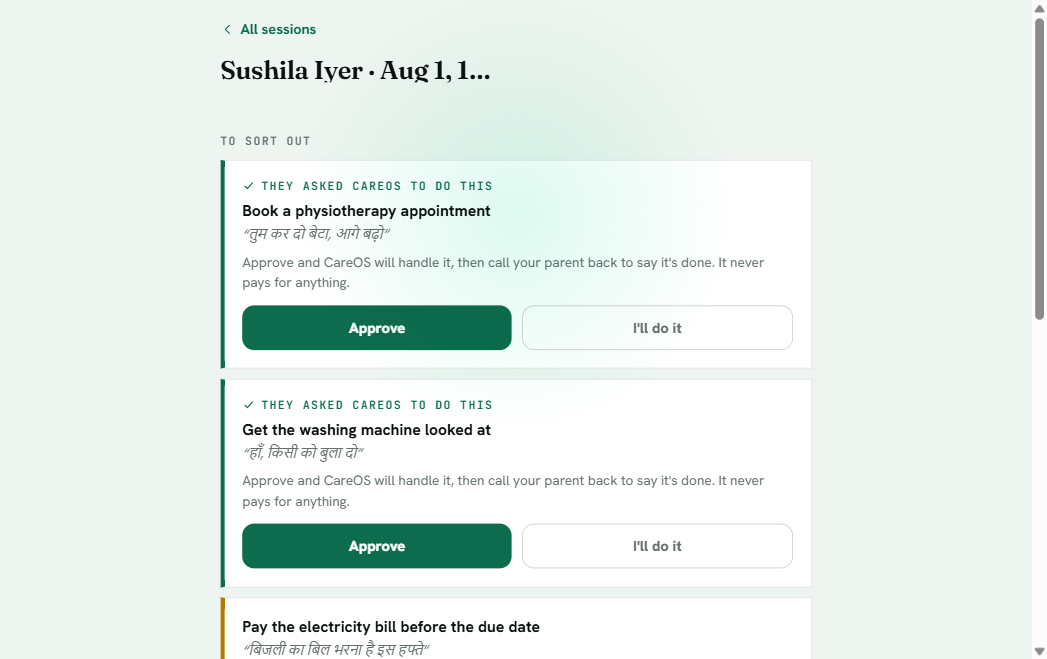
The family checklist: 'They asked CareOS to do this' cards carrying the parent's consent in her own Hindi words, with one-tap Approve.

The parent's consent, quoted in her own words, waiting on the child's one tap. The app never silently forgets something a parent asked for.
11
Product · in-call execution

It doesn't just listen. With consent, it acts, during the call.

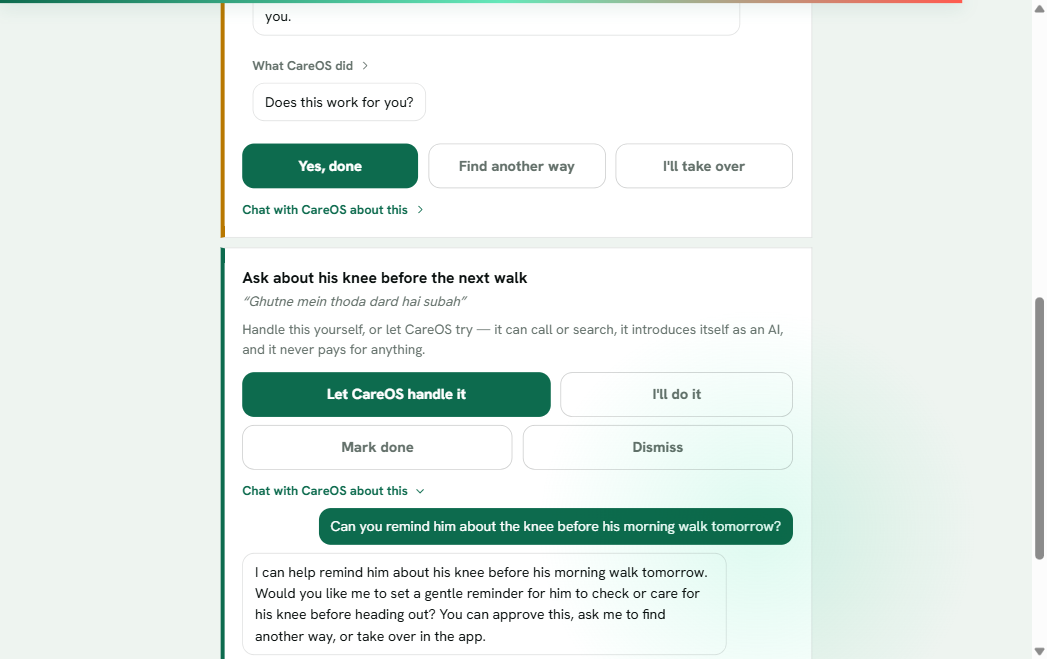
A task the parent asked for on a call, with CareOS's live chat thread: the family asks a question and the agent answers about that task.

The parent agrees on the phone → the agent files it and finds options while they wait → the family gets the findings and one tap releases it. They can chat with CareOS about any task. Money never moves: payment-shaped requests are refused in code, not in a prompt.
In-call task tool + per-task chat, live in production
12
Product · the family app

For the child who left, and still lies awake about it.

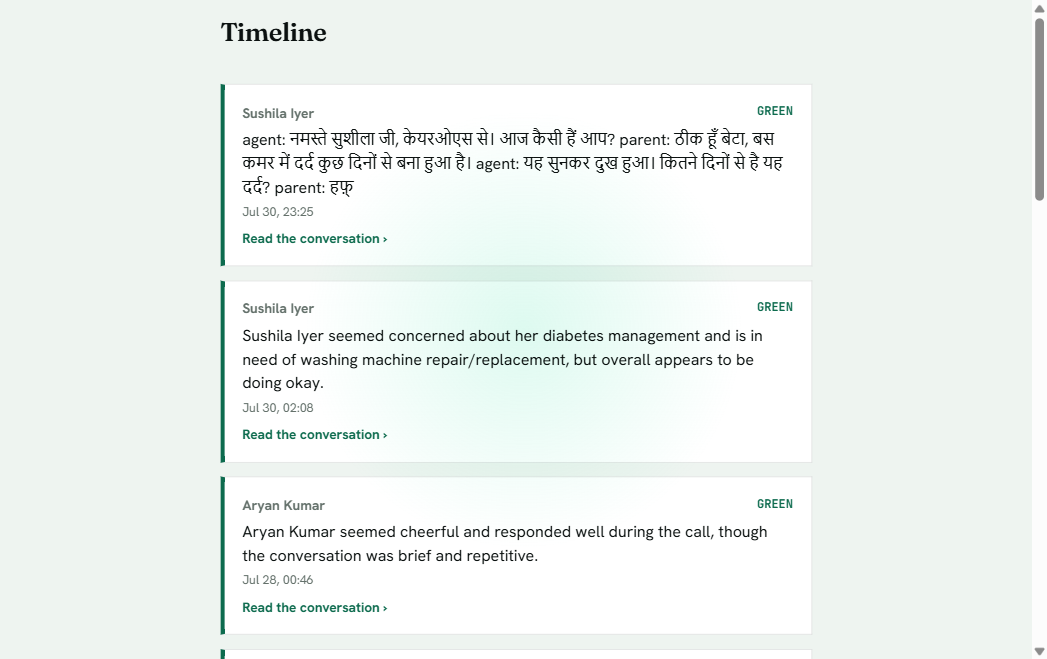
The CareOS family app: a timeline of what the parent actually said on each daily call, with the agent's proposals waiting for approval.

Read what your mother actually said, not a summary of it. Approve what the agent proposes. Be told the moment something is wrong.
careos.co.in/family
13
Traction

Three care organisations. Twelve paying customers. Zero spend.

3care organisations signed to onboard and pay: QuroCare (Trivandrum, India), GeroCare (Nigeria), and new pilot Home Healthcare Pvt Ltd
$39per patient, per month: the commission agreed before any sales team existed
12paying customers, all from organic LinkedIn and Facebook. Zero paid acquisition, live Stripe billing

I started building for Japan. None of my first partners is in Japan. That is what made me stop building a Japanese product.

Unpaid family caregiving in the US alone is now valued at $1.01 trillion a year, more than all federal, state and local Medicaid spending combined (AARP, Valuing the Invaluable 2026)
14
Live today

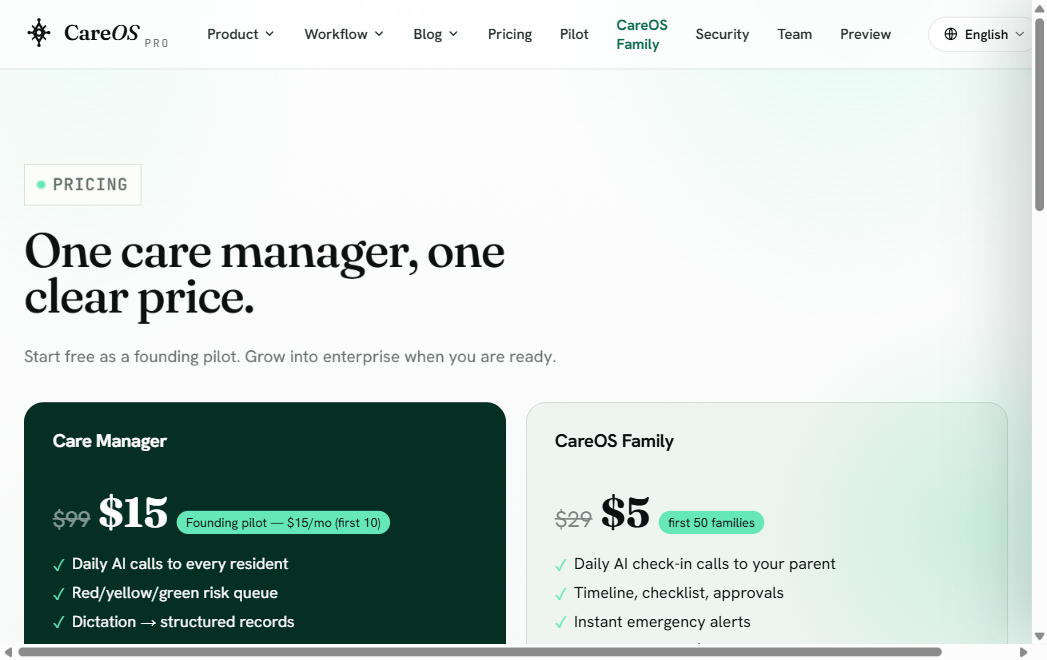
$5 for the first 50 families. $15 for the first 10 agencies.

The live CareOS pricing page: Pro at a $15/month founding pilot, Family at $5/month for the first 50 families.

Pay with your email and that email becomes your login. Checkout, entitlement, and app access are one wired loop, with the pilot caps enforced in the database, not on the landing page.

careos.co.in/pricing
15
Product-market fit

Five signals, none of them bought.

Demand arrived from markets I wasn't selling to

I built for Japan. My partners are QuroCare (Trivandrum, India), GeroCare (Nigeria) and now Home Healthcare Pvt Ltd. All three found me.

They agreed to a price before a sales team existed

$39 per patient per month, from care organisations that do this for a living and did the maths themselves.

Zero paid acquisition, and they pay

12 paying customers from organic LinkedIn and Facebook alone. No ads, no sales team, live Stripe billing.

The capital agrees on the wedge

All eight largest 2025–26 rounds in this space sold B2B. Our sequencing matches where the money already went.

The elders keep talking

A real Hindi call ran 17 turns over three and a half minutes, unprompted, with no drop-off.

It is the founder's own problem

I am an immigrant with parents in another country. I am the customer on the family side, and I built this because I needed it.

16
The other half of the market

304 million people live in a different country from their parents.

304
International
migrants (2024)
37
Overseas Indians
(NRI + PIO)
63
US unpaid family
caregivers
32
India 60+
living alone or
spouse-only
Millions of people

Migration is 3.7% of humanity and rising. Every one of those people has parents somewhere else, and no way to know how today went.

UN DESA International Migrant Stock 2024 (304M, 3.7% of world population) · India MEA, Jan 2026 (37.28M overseas Indians) · AARP/NAC Caregiving in the US 2025 (63M) · UNFPA/IIPS India Ageing Report 2023 (about one fifth of India's 60+ live alone or with only a spouse)
17
Market

We are not sizing a software category. We are sizing the work being done unpaid.

Unpaid US family caregiving
1010
US 'other health, residential & personal care'
320
US home care providers industry
192
US home health care spending
169
India senior care industry
7
Japan care-management fees (居宅介護支援)
3.7
Annual value, US$ billions

The $1.01 trillion is the ceiling: work families already do for free, which exceeds all US Medicaid spending combined. The paid lines beneath it are what is already transacting. The smallest of them is where CareOS bills today.

AARP Valuing the Invaluable 2026 ($1.01T, 2024 data) · CMS/Health Affairs National Health Expenditure 2024 ($169.4B home health; $320.5B other health/residential/personal care) · IBISWorld NAICS 62161 (2026) · NITI Aayog Senior Care Reforms in India 2024 ($7B) · MHLW 介護給付費 FY2024 (¥552.3bn ≈ $3.7B)
18
Where we sit

From three organisations to the layer both sides depend on.

Today · we bill here

Care-organisation commissions and family subscriptions. Three signed partners at $39 per patient per month, 12 paying customers, live Stripe billing.

Next · the reachable slice

2,500 agencies and 70,000 paying families is roughly $99M ARR. One tenth of one percent of US caregivers, before India or Japan.

Then · the layer itself

Once the record is what an agency bills against and the family's history lives here, CareOS is infrastructure. That is the $1B line.

Bottom-up from live pricing, not a share-of-market estimate. The seven research firms sizing 'home health software' disagree by 4.9×, so we do not use their numbers.

19
Business model

Three revenue lines, and one patient can pay on all three.

LineWho paysPrice
Care-manager seatsThe agency$99 / care manager / month ($15 founding pilot)
Family subscriptionThe adult child$29 / $79 / $149 per month ($5 founding pilot)
Marketplace matchThe agency, per matched patient$29–39 / patient / month

A family on $79 whose mother is served by a partnered agency generates ~$110/month from two payers, neither paying full freight.

20
The arithmetic

Where this reaches $100M, and why it does not stop there.

11
Beachhead
300 agencies
8,000 families
99
Scale
2,500 agencies
70,000 families
1074
Ceiling
20,000 agencies
800,000 families
ARR, US$ millions

Scale needs 70,000 paying families worldwide: one tenth of one percent of the 63 million unpaid family caregivers in the US alone, before counting India, Japan or the Gulf.

Bottom-up from live pricing: $99/seat, blended $70 family ARPU, $29 per matched patient, 40% agency attach.
21
Why the buyer says yes

Where reimbursement is capped, software is revenue.

In Japan, reimbursement per case is cut from the 45th patient, or the 50th if the agency uses the government's care-plan data system. Care managers already average about 45. Agency revenue is therefore bounded by headcount, and the software that raises the threshold pays for itself.

An agency bills roughly ¥15,500 (~$100) per user per month for care management. CareOS costs about $2 per patient per month. That is arithmetic an owner does in their head.

Every country with an elder-care system has its own version of this ceiling.

QuroCare, GeroCare and Home Healthcare agreed to $39 because the maths worked, not because the demo was charming.

MHLW 社保審-介護給付費分科会 第259回 (2026-06-29): 44-user staffing standard, 逓減制 fee taper, 居宅介護支援費(II) ICT threshold; ¥15,500 average per user/month (介護給付費等実態統計)
22
How we differ

Everyone stops at the summary. The record is where the money is.

Everyone else
Call the patient
Transcribe
Summarise
Email the family
CareOS
Call in their language
Detect risk mid-call
Draft the record
Human approves
Agency bills · family acts

The first steps are a commodity: four companies shipped them this year. The last two are national regulation, and they are why an agency can adopt us at all and why a family gets something they can act on.

23
Competition & moat

Everyone sells the conversation. We sell the record.

The reimbursable record

A voice agent ports across borders in a weekend. A record that gets a care organisation PAID does not: payment rules are national, and nobody wants to build that. We started against one of the strictest regimes in the world.

Both sides of one relationship

Families arrive with a problem and a credit card. Agencies arrive with capacity and no acquisition channel. Every competitor picked one side.

The memory compounds

Medications, call history, and the family's document vault (prescriptions, insurance policies, bills), filed, searchable, and turned into reminders. Once the agency bills against the record and the family's paperwork lives in it, leaving is genuinely expensive.

The field is real and funded: Hippocratic AI ($3.5B), Kaigo Health (YC F25), inTouch, and in Japan Welmo (¥5.6B raised, already shipping care-plan AI to our buyer). And 'no app for the elder' is table stakes, not a moat: at least eight companies say it.

The honest version of the 'no app' claim is not device ownership (78% of US over-65s own a smartphone). It is that apps get abandoned after one confusing interaction, and a phone call never does.
24
What is actually built

Live in production today, not a prototype.

The voice stack

Streaming telephony agent, 17 languages, sub-second responses, mid-call emergency escalation, in-call task execution, and two interchangeable voice stacks (our tuned pipeline and a Deepgram Flux lane), A/B-able per call.

The platform

Two web apps, a mobile app, encrypted health data, payments wired end to end (Stripe → entitlement → login), audited access control, 484 automated tests.

Built solo

Alongside a full-time job. Every evening, weekend and holiday for the last four months.

Reviewers can log into both products today and place a real call.

Private preview: careos.co.in/preview
25
Trust & security

Built like the health product it is, not the demo it started as.

Encrypted where it matters

Health data is encrypted at the field level, not just at the disk. Keys live in the environment, never in code, never in a prompt.

Gated in code, not in policy

Role-isolated APIs (a family token can never read another family, or any agency's caseload), payment entitlements enforced server-side, every sensitive action audit-logged.

Human-approved by construction

The approval gate is architecture, not a setting a rushed operator can switch off. Money cannot move through CareOS because no code path exists for it.

484 automated tests run on every change. The same discipline the founder ships professionally, applied to his own company.

26
Advisors & the next 12 months

The map is drawn. The constraint is nights and weekends.

Advised by people who know the buyer

Matthew Holt, a US healthcare expert, and Shota Atago advise on go-to-market, and independently pointed at the same US opening: affluent diaspora families and demographically burdened care agencies.

The next 12 months

Convert the three signed organisations into paying per-patient deployments. Grow the founding-family cohort past its pilot caps. Land the first Japanese agency against LTCI. Hire the first engineer.

Everything on this list extends what is already running in production. None of it is greenfield.

27
The ask

Let me do this full-time.

Raising a pre-seed to convert three signed care organisations into paying deployments, prove the per-patient economics in India and Nigeria, and hire the first engineer.

The larger picture: an operating system for growing old. Every elder reachable by an ordinary phone, in all 17 languages and counting, with a care organisation on one side and a family on the other.

The product works. The demand found me. The only constraint left is that I am building it part-time.

Aryan Kumar · Osaka, Japan · aryan@careos.co.in · careos.co.in

28
← → / space · click to advance